
DTR-7
Description
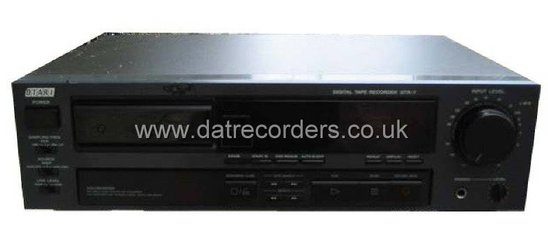
The The Otari DTR-7 is a professional DAT recorder with +4dBu Active Balanced Analog Input/Output and AES/EBU / SPDIF Digital Audio Interface.
The DTR-7 was designed for use in recording studios, theaters or halls, and many other situations.
Features
- R-DAT Standard Format: The DTR-7 conforms to the basic format established by the EIAJ/DAT Conference and provides complete electrical and tape compatibility with other R-DAT machines.
- Three Sampling Frequencies: Recording at 48 kHz, 44.1 kHz, and 32 kHz is available. The 32 kLP (long play) mode and 44 kWT (wide track, playback only) mode are also available.
- Precise Tracking Mechanism: The DTR-7 can be operated in 32 kLP mode due to the precise tracking mechanism.
- 1-Bit A/D and D/A Converter: The DTR-7 is equipped with a Delta Sigma type 1-bit A/D and 1-bit D/A converter.
- Start ID Editing: In addition to the Start ID writing/erasing function, Auto ID Edit and Auto Renumber functions are also available.
- Sampling Monitor Function: The input signal can be monitored through the A/D and D/A Converters of the DTR-7. This function allows the DTR-7 to be utilized as an A/D or D/A Converter.
- Wireless Remote Controller: Every DTR-7 has a wireless remote controller, CB-152, as a standard accessory.
- Bar Graph Peak Meters: The 20-segment Bar Graph Peak Meters feature a peak hold function.
- Active Balanced Analog Input/Output: Analog signals are input/output through the XLR type connectors using the transformerless active balanced circuitry.
- Selectable Digital Audio Interface: The DTR-7 is equipped with AES/EBU and SPDIF digital interface.
- Parallel Remote Interface: The DTR-7 is equipped with a parallel remote interface which allows connection with Mixing Console switches or theoptional Parallel Remote Controller CB-156-S.
- Wired Serial Remote Controller CB-154-S (optional): The optional serial remote controller has the same design and same functions as the provided Wireless Remote Controller. This provides a wider operational area because distance and obstacles have no effect.
Technical Specifications
| Transport mechanism | 2-Head Mechanism (including head assembly), Tray-type Cassette Loading |
| Track format | Conforms to R-DAT Standard |
| Load speed | 6 sec |
| Eject speed | 4 sec |
| Tape speed (normal) | 8.15 mm/sec |
| Tape speed (44k wide-track) | 12.225 mm/sec |
| Tape speed (32k LP) | 4.075 mm/sec |
| Fast wind time | Max. 60 sec (200 times, with 120 minute tape) |
| Play start-up time | Max. 2 sec |
| Tension servo | Closed Loop Tension Servo |
| Frequency response (48/44.1 kHz) | 20Hz~20 kHz ±0.5 dB |
| Frequency response (32 kHz) | 20Hz~14.5 kHz ±0.5 dB |
| Dynamic range | Min. 90 dB (EIAJ) |
| S/N ratio | Min. 88 dB (emphasis off, with DIN audio filter) |
| THD | Max. 0.08% (maximum level -18 dB, 1 kHz) |
| Crosstalk | Min. 75 dB (1 kHz) |
| Sampling frequency | 48 kHz / 44.1 kHz / 32 kHz (manual selection for analog recording, automatic for digital recording/playback) |
| De-emphasis | 50 µsec/15 µsec (selected automatically for playback) |
| Phase difference between channels | Max. 10° (20 kHz) |
| Meter | 20-segment Peak Level Meter (with peak hold) |
| Analog input mode | Transformerless Active Balanced |
| Analog input impedance | 10 kΩ |
| Analog input SRL level | +4 dBu / -16 dBu (selectable) |
| Analog input maximum level | +28 dBu |
| Analog input connector | XLR3-31 (changeable to XLR3-32) |
| Analog output mode | Transformerless Active Balanced |
| Analog output impedance | Max. 5Ω |
| Analog output load impedance | Min. 600Ω |
| Analog output SRL level | +4 dBu / -16 dBu (selectable) |
| Analog output maximum level | +26 dBu |
| Analog output connector | XLR3-32 (changeable to XLR3-31) |
| AES/EBU digital input format | EIAJ CP-340 Type-I / IEC 958 (AES/EBU) with transformer |
| AES/EBU digital input impedance | 110Ω |
| AES/EBU digital input connector | XLR3-31 |
| AES/EBU digital output format | EIAJ CP-340 Type-I / IEC 958 (AES/EBU) with transformer |
| AES/EBU digital output impedance | 110Ω |
| AES/EBU digital output connector | XLR3-32 |
| SPDIF digital input format | EIAJ CP-340 Type-II / IEC 958 (SPDIF) |
| SPDIF digital input impedance | 75Ω |
| SPDIF digital input connector | RCA Pin |
| SPDIF digital output format | EIAJ CP-340 Type-II / IEC 958 (SPDIF) with transformer |
| SPDIF digital output impedance | 75Ω |
| SPDIF digital output connector | RCA Pin |
| Serial interface format | DTR-7 Original Protocol |
| Serial interface connector | 6.3 mm Stereo Phone Jack |
| Parallel input format | DTR-7 Original Protocol |
| Parallel input connector | D-Sub 9 Pin |
| Headphone load impedance | Min. 8Ω |
| Headphone connector | 6.3 mm Stereo Phone Jack |
| Power supply | AC 100/110/117/200/220/240V ±10% selectable, 50/60 Hz |
| Power consumption | Max. 34 VA |
| Operating temperature | 5°C~40°C |
| Operating humidity | 20%~80% |
| Storage temperature | -20°C~+45°C |
| Storage humidity | 10%~80% |
| Dimensions | 435(W) × 135(H) × 336(D) mm (without rack mount adapter, including feet and knobs) |
| Weight | Approx. 7.8 kg |
| Accessories | CB-152 Wireless Remote Control Unit (1), AAA batteries (2), ZA-75R Rack Mount Adapter (1), PZ9D003 Power Cable (1), FH7F0050 0.5A Fuse 125V (1), FH9-024 1A Fuse 250V Time Lag (1), FH7F037 1.25A Fuse 125V Time Lag (1), FH9-020 2A Fuse 125V (1), OS3-373 Operation Manual (1) |
| Optional accessories | CB-154-S Wired Serial Remote Control Unit, CB-156-S Parallel Remote Control Unit |
Gallery

Documents
User Manual
Otari DTR-7 User Manual
Not yet available
Service Manual
Otari DTR-7 Service Manual
Not yet available