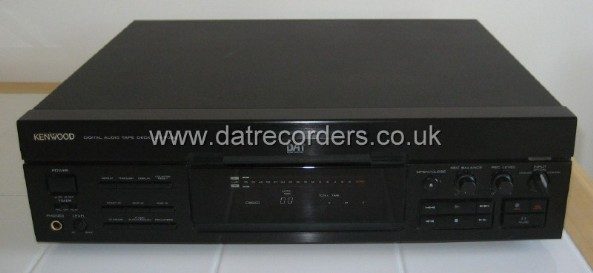
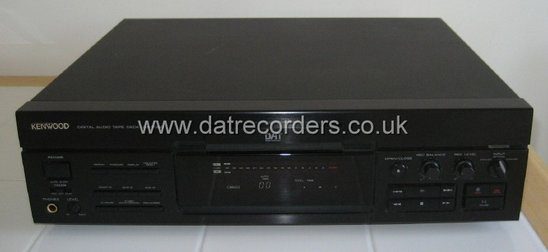
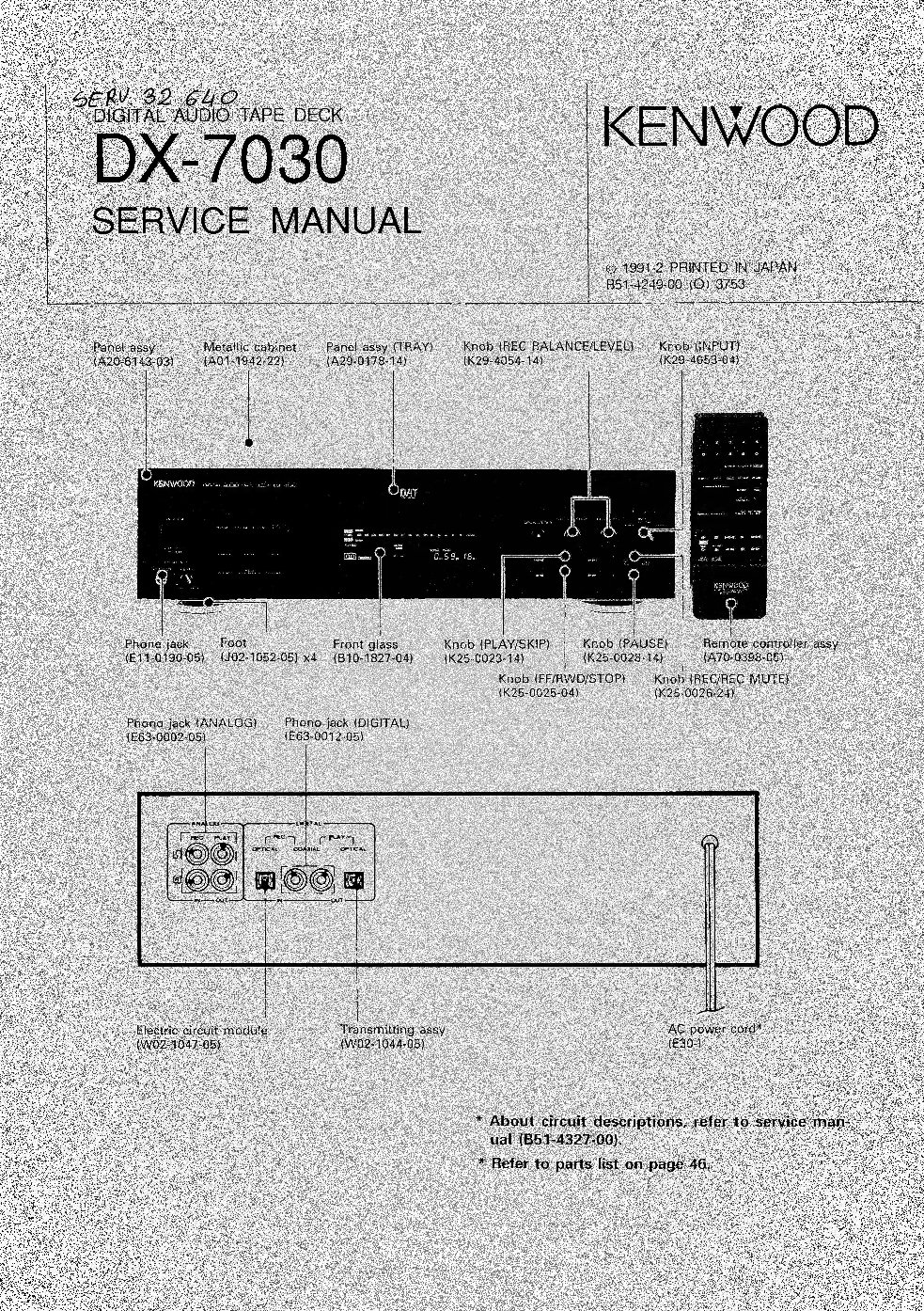
Kenwood released the DX-7030 in November 1990.
The DX-7030 was designed as a domestic unit but aspires to top quality, no-compromise sound quality, having a centrally mounted tape drawer and special internal damping plus a massive base-plate to improve isolation.
One-bit technology is employed with third-order noise shaping used for replay and fourth-order, 64-times oversampling used in recording from analogue sources.
Full editing of subcode and table-of-contents files is available, making the unit compatible with professional applications.
Two head design, and a total of 6 motors (capstan, drum and 4 loading)
The DX-7030 orginally cost 699.95 GBP.
SCMS Compatibility
By adopting the SCMS method, first-generation digital-to-digital recording in 44 kHz mode — previously impossible — became possible.
Centre-of-Gravity Mechanical Layout
The helical scan head is positioned to coincide with the centre of gravity of the housing, determined by vibration analysis for the most ideal mechanical arrangement. Vibration is further reduced by a high-rigidity chassis based on 1.6 mm steel plate with a box-bridge structure mechanical floor.
Triple Independent Crystal Oscillators
Three independent crystal oscillators are provided — one for each of the 48 kHz, 44.1 kHz, and 32 kHz frequencies required for DAT A/D and D/A conversion — each with the shortest possible circuit layout to minimise jitter and external interference. A high-precision master clock system oscillates the reference signal using an equivalent circuit method to prevent amplification of interference noise.
1-Bit Pulse D/A Converter
The D/A converter employs a 1-bit pulse converter for superior differential linearity. The master clock operates at 1024× oversampling for smooth conversion, combined with a multiple-feedback analogue low-pass filter to suppress phase characteristic variation.
64fs Delta-Sigma A/D Converter
The A/D converter uses a 64fs ΔΣ converter with a 4th-order noise shaper. A double-sequence digital PLL circuit in a two-stage configuration minimises reference frequency shift and jitter.
High-Speed DPSS Search
Direct Programme Search System (DPSS) uses U-TOC absolute information for high-speed programme search, recognising total tape time and total track count for fast, accurate detection.
Isobobbin Power Transformer
Five dedicated windings are provided for rotation servo, display tube drive, audio power supply, and other circuits to minimise mutual interference between stages.
D/A Monitor Function
The D/A converter can be used independently as a standalone D/A monitor.
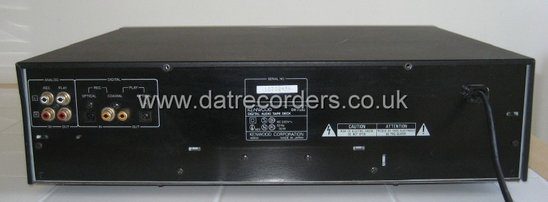
Relay-Switched Coaxial Input
The coaxial input is completely switched by relay to eliminate potential differences between devices, enabling high-purity recording via optical input. A flashing digital indicator warns when no signal is present, preventing accidental blank recording.
Subcode Editing
Full subcode editing including Start ID, Skip ID, End ID, ID erase, Auto Start ID, and renumbering. U-TOC information writing enables music number rearrangement.
Display Functions
Switchable display modes: total time, single-track time, remaining time, and counter display. Wireless remote control included.
| Type | Digital audio tape deck with rotating head system |
| Heads | Two rotating heads (sputtered sendust heads) |
| Motors | 6 motors — DD motor (capstan), DD motor (drum), DC motor (loading) ×4 |
| Tape speed | 8.15 mm/s |
| Recording time | 120 minutes (with DR-120 tape) |
| Rewind time | Approx. 40 sec (with 120-minute recorded tape) |
| Number of channels | 2-channel stereo |
| Sampling frequency (record) | 48 kHz, 32 kHz (digital input only) |
| Sampling frequency (playback) | 48 kHz, 44.1 kHz, 32 kHz |
| Quantization | 16-bit linear |
| Frequency response | 2Hz~22 kHz |
| S/N ratio | More than 93 dB |
| Dynamic range | More than 92 dB |
| Total harmonic distortion | Less than 0.005% |
| Wow and flutter | Below measurable limit |
| Line input level | 500 mV, input impedance 10 kΩ |
| Digital coaxial input | 0.2V (P-P), input impedance 75Ω |
| Digital optical input | -15 dBm~-24 dBm (660 nm) |
| Line output level | 2V RMS, output impedance 1 kΩ |
| Digital coaxial output | 0.5V (P-P), output impedance 75Ω |
| Digital optical output | -18 dBm (wavelength 660 nm), rectangular type |
| Headphone output | 20 mW (16Ω), stereo standard jack |
| Power consumption | 30W |
| Dimensions | 440(W) × 127(H) × 370(D) mm |
| Weight | 9.6 kg |
PDF downloads delivered instantly after payment via PayPal. Download links expire 48 hours after purchase.
By purchasing you agree to our terms and conditions.
By purchasing you agree to our terms and conditions.